- English
- French
- German
- Portuguese
- Spanish
- Russian
- Japanese
- Korean
- Arabic
- Irish
- Greek
- Turkish
- Italian
- Danish
- Romanian
- Indonesian
- Czech
- Afrikaans
- Swedish
- Polish
- Basque
- Catalan
- Esperanto
- Hindi
- Lao
- Albanian
- Amharic
- Armenian
- Azerbaijani
- Belarusian
- Bengali
- Bosnian
- Bulgarian
- Cebuano
- Chichewa
- Corsican
- Croatian
- Dutch
- Estonian
- Filipino
- Finnish
- Frisian
- Galician
- Georgian
- Gujarati
- Haitian
- Hausa
- Hawaiian
- Hebrew
- Hmong
- Hungarian
- Icelandic
- Igbo
- Javanese
- Kannada
- Kazakh
- Khmer
- Kurdish
- Kyrgyz
- Latin
- Latvian
- Lithuanian
- Luxembou..
- Macedonian
- Malagasy
- Malay
- Malayalam
- Maltese
- Maori
- Marathi
- Mongolian
- Burmese
- Nepali
- Norwegian
- Pashto
- Persian
- Punjabi
- Serbian
- Sesotho
- Sinhala
- Slovak
- Slovenian
- Somali
- Samoan
- Scots Gaelic
- Shona
- Sindhi
- Sundanese
- Swahili
- Tajik
- Tamil
- Telugu
- Thai
- Ukrainian
- Urdu
- Uzbek
- Vietnamese
- Welsh
- Xhosa
- Yiddish
- Yoruba
- Zulu
Carburizing Pit Furnace
Operating Temperature: 100-1300℃
Power: 5-3000KW
Dimensions: 500-50000mm
Application: Heat treatment of metal parts
Minimum Order Quantity: 1 unit
Customization: Supports on-demand customization, ODM/OEM customization
Packaging: Standard export container, customization supported
Carburizing Pit Furnace for Deep Case Hardening of Long Steel Components
Our Carburizing Pit Furnace delivers uniform carbon diffusion and minimal thermal distortion for critical power transmission components. This vertical batch-type furnace operates between 100-1300°C with temperature uniformity of ±5°C (Class 2 per AMS 2750F), ensuring precise carbon potential control within ±0.02%. The pit design supports vertical loading of long parts up to 50 tons, preventing gravity-induced sagging during prolonged heat cycles. Built with composite fiber insulation and energy-saving microsphere bricks, it reduces operational costs while maintaining consistent case depths exceeding 3mm on large-diameter workpieces.
What Makes Our Pit-Type Carburizing System Different?
Vertical Loading Design Prevents Part Distortion
The vertical orientation solves a persistent problem in heat treatment: long shafts and slender components tend to warp when laid horizontally at temperatures above 900°C. By suspending parts vertically in our furnace, you eliminate gravitational stress. This design is particularly valuable when processing:
· Transmission shafts longer than 2 meters
· Thin-walled gear blanks requiring tight tolerances
· Automotive axle components with strict straightness requirements
Natural convection within the sealed retort chamber ensures uniform temperature distribution from top to bottom.
Controlled Atmosphere for Precise Carbon Penetration
Carbon potential (Cp) management is critical in achieving your target case depth. Our furnace uses a high-nickel alloy retort (Cr25Ni20 grade) with forced circulation via centrifugal fans. This setup allows you to:
· Maintain stable carbon concentration throughout the boost and diffuse stages
· Process mixed batches with varying case depth requirements
· Reduce cycle time by up to 20% compared to static atmosphere systems
The integrated PLC control system adjusts gas flow rates automatically, responding to real-time carbon probe feedback.
Energy-Efficient Insulation Structure
Conventional pit heaters lose noteworthy warm through the best opening and sidewalls. We've tended to this with a three-layer separator approach:
1. Inner layer: Ultra-lightweight high-strength microsphere bricks withstand coordinate contact with the warmed retort
2. Middle layer: Composite fiber cover cotton gives warm resistance with negligible warm mass
3. Outer layer: Heavy-duty high-alumina bricks guarantee long-term basic integrity
This setup diminishes warm misfortune by roughly 35% compared to routine plans, bringing down your power or gas utilization per group.
Technical Specifications
|
Parameter
|
Value / Range
|
|
Operating Temperature
|
100-1300°C
|
|
Temperature Uniformity
|
±5°C (Class 2, AMS 2750F)
|
|
Carbon Potential Precision
|
±0.02%
|
|
Power Rating
|
5-3000 kW (application-dependent)
|
|
Maximum Load Capacity
|
Up to 50 tons
|
|
Furnace Depth (customizable)
|
500-50000 mm
|
|
Retort Material
|
High-nickel alloy (Cr25Ni20 / SUS310S)
|
|
Insulation Type
|
Ceramic fiber + microsphere brick composite
|
|
Control System
|
PLC with multi-stage profiling capability
|
|
Compliance Standards
|
GB/T 9452, CQI-9, AMS 2750F
|
How the Carburizing Process Works in Our Pit Furnace?
Step 1: Loading
You load workpieces through the top access opening. Long shafts are suspended from fixtures, while smaller gears can be arranged in baskets. The opening is then sealed with a heavy lid to maintain atmosphere integrity.
Step 2: Heating and Carbon Boost
Electric heating elements or gas burners raise the retort temperature to your setpoint (typically 900-950°C for carburizing). Carbon-rich gas (endothermic or synthetic atmosphere) is introduced. During the boost phase, carbon atoms diffuse rapidly into the steel surface.
Step 3: Diffusion and Soaking
Gas composition shifts to a lower carbon potential, allowing carbon to migrate deeper into the part cross-section. This stage determines your final case depth—longer diffusion times yield deeper cases.
Step 4: Quenching and Unloading
Parts are either quenched directly in an integrated oil or polymer bath, or transferred to a separate quench tank. After cooling, you lift components out using overhead cranes or manual hoists, depending on batch size.
This four-stage cycle ensures you achieve the hard surface layer (58-62 HRC typical) with a tough core (30-40 HRC), critical for components facing contact fatigue and bending loads.
Where You'll Use This Equipment?
Heavy Power Transmission Manufacturing
Wind turbine gearboxes and mining equipment require gears with case depths often exceeding 3mm. The vertical design of our Carburizing Pit Furnace accommodates these massive components without risk of warpage, maintaining dimensional tolerances within ±0.05mm after heat treatment.
Aerospace Component Hardening
Landing gear struts and high-strength fasteners demand strict microstructure control and atmosphere purity. Our sealed retort system prevents oxidation and decarburization, meeting aerospace material specifications such as AMS 6260 and AMS 6274.
Automotive Drivetrain Production
Transmission gears and differential pinions are created in tall volumes. Bunch handling in a controlled carbon-rich environment gives you the throughput required for 24/7 generation plans, whereas keeping up steady quality over thousands of parts.
Why Choose Hebei Bolin for Your Heat Treatment Needs?
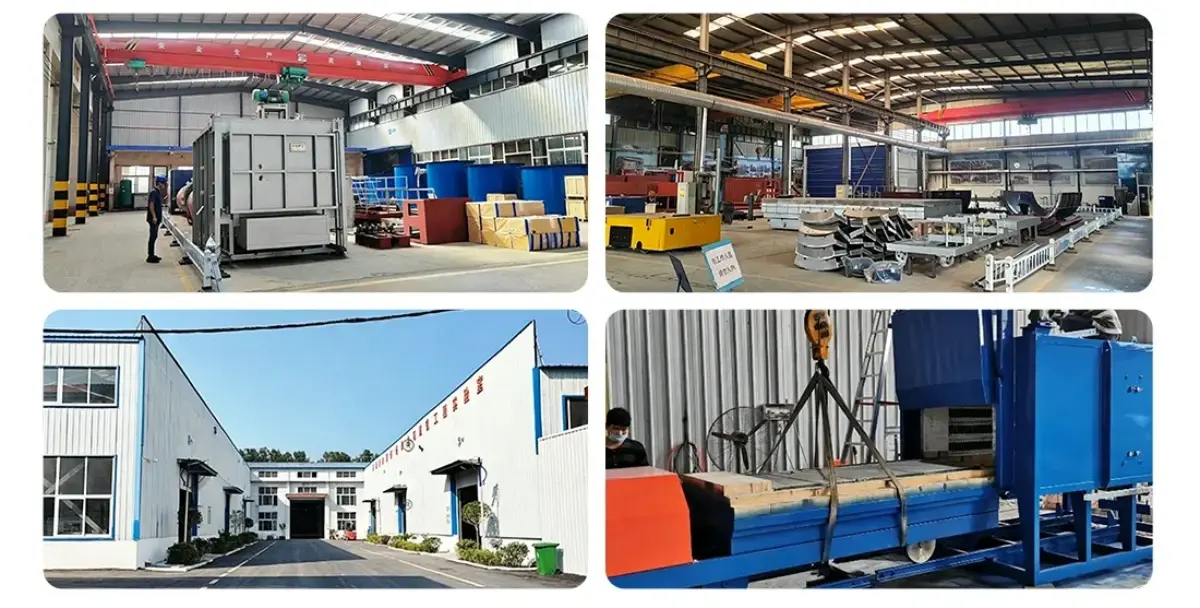
Hebei Bolin Electric Heater Fabricating Co., Ltd. has specialized in mechanical warm treatment hardware since our foundation. Found in Zhenggang Mechanical Stop, we combine designing plan, fabricating, and after-sales benefit beneath one roof.
What we offer:
· Custom building: We plan heaters based on your portion geometry, generation volume, and office format. Send us your drawings and requirements—we'll give a custom-made solution.
· Fast conveyance: Standard arrangements transport inside 10-40 days. We keep up component stock to react rapidly to pressing projects.
· Full bolster: Our group gives on-site establishment, commissioning, and administrator preparing. A 1-year guarantee covers parts and specialized assistance.
· Compliance center: All hardware meets national energy-saving measures and universal warm treatment framework evaluations (CQI-9).
We moreover offer ODM and OEM administrations for gear producers and designing firms requiring private-label arrangements.
Frequently Asked Questions
Q: What's the normal case profundity I can achieve?
A: Case profundity depends on time and temperature. For most medium-carbon steels (like 20CrMnTi), you can anticipate 0.8-1.2mm after an 8-hour cycle, or 2.5-3.5mm with amplified 16-20 hour forms. We'll offer assistance you calculate the ideal cycle for your fabric grade.
Q: Can I prepare distinctive portion sizes in one batch?
A: Yes, but you'll require to gather parts with comparable case profundity prerequisites. Our PLC framework permits for a few variety through zone-controlled climate administration, but extraordinary contrasts (e.g., 0.5mm vs 3mm) ought to be prepared independently for best results.
Q: How do you avoid oxidation amid the process?
A: The fixed counter works beneath positive weight with a controlled climate (endothermic gas or nitrogen-methanol blend). Carbon tests persistently screen oxygen levels, and the framework cleanses any discuss interruption consequently. Surface wrap up after carburizing is ordinarily shinning with negligible oxide scale.
Q: What's the control utilization compared to flat furnaces?
A: Pit heaters by and large devour 15-25% less vitality per kilogram of treated parts, much appreciated to the vertical design's characteristic convection and our progressed separator bundle. Correct reserve funds depend on your group weight and cycle frequency—we can give calculations based on your generation data.
Q: Do you give establishment exterior of China?
A: Yes. We offer specialized direction and can orchestrate for our engineers to administer establishment and commissioning at your office. Preparing for your upkeep group is included in the benefit bundle.
Get Started with a Custom Solution
Every production environment has unique requirements. Whether you're hardening 500mm diameter gears or processing batches of automotive shafts with a Carburizing Pit Furnace, we'll configure a furnace that fits your workflow.
Contact our engineering team: 15720259172@163.com
Learn about our latest products and discounts through SMS or email