- English
- French
- German
- Portuguese
- Spanish
- Russian
- Japanese
- Korean
- Arabic
- Irish
- Greek
- Turkish
- Italian
- Danish
- Romanian
- Indonesian
- Czech
- Afrikaans
- Swedish
- Polish
- Basque
- Catalan
- Esperanto
- Hindi
- Lao
- Albanian
- Amharic
- Armenian
- Azerbaijani
- Belarusian
- Bengali
- Bosnian
- Bulgarian
- Cebuano
- Chichewa
- Corsican
- Croatian
- Dutch
- Estonian
- Filipino
- Finnish
- Frisian
- Galician
- Georgian
- Gujarati
- Haitian
- Hausa
- Hawaiian
- Hebrew
- Hmong
- Hungarian
- Icelandic
- Igbo
- Javanese
- Kannada
- Kazakh
- Khmer
- Kurdish
- Kyrgyz
- Latin
- Latvian
- Lithuanian
- Luxembou..
- Macedonian
- Malagasy
- Malay
- Malayalam
- Maltese
- Maori
- Marathi
- Mongolian
- Burmese
- Nepali
- Norwegian
- Pashto
- Persian
- Punjabi
- Serbian
- Sesotho
- Sinhala
- Slovak
- Slovenian
- Somali
- Samoan
- Scots Gaelic
- Shona
- Sindhi
- Sundanese
- Swahili
- Tajik
- Tamil
- Telugu
- Thai
- Ukrainian
- Urdu
- Uzbek
- Vietnamese
- Welsh
- Xhosa
- Yiddish
- Yoruba
- Zulu
Why Are Steel Furnace Bottom Plates Preferred in Heavy Industries?
Steel furnace bottom plates are essential to solid industrial heat processing because they retain their form in demanding conditions. The bottom plate foundation directly impacts operational safety, process uniformity, and long-term cost-effectiveness when processing heavy workpieces above 1200°C. Steel alloys, notably those containing 18% chromium and 8% nickel, don't flex when heated or cooled fast and keep flat after years of usage. These attributes make steel the greatest material for forging in the automotive sector, heat treating metal in airplanes, and manufacturing heavy steel, where equipment failure might affect production and safety.
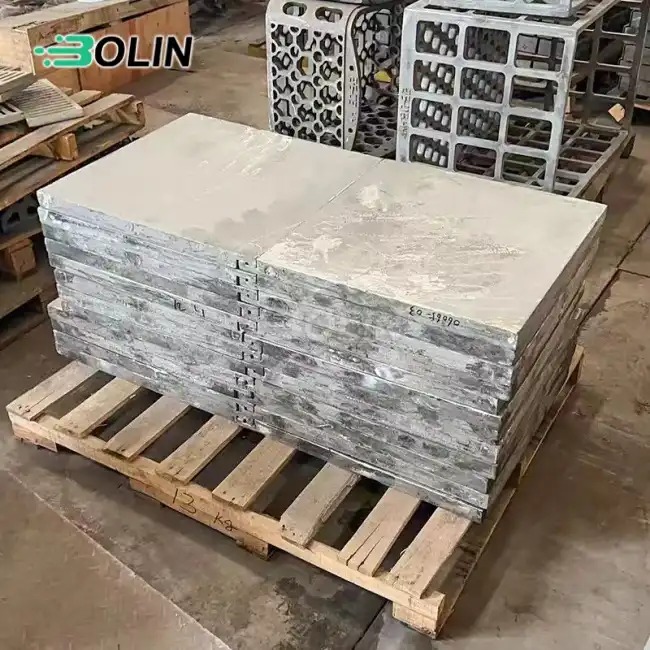
Understanding Furnace Bottom Plates and Their Industrial Functions
The Role of Bottom Plates in Thermal Processing Systems
Industrial heating systems' furnace bottom plates support workpieces during heat treatment cycles directly on the fire. This section must distribute mechanical stresses from large castings or forgings, distribute thermal energy evenly over the processing area, and protect the furnace structure from chemical assaults from process atmospheres and molten slag. To maintain regulated oxygen when pit furnaces carburize car transmission gears, the Furnace Bottom Plate seals against the furnace shell. Tool steel batch setups require plates that don't bend when heated and cooled fast to 950°C. For continuous roller hearth furnaces, clearance holes must be precisely constructed to accommodate material handling equipment without compromising the framework. Varying applications need varying dimensional stability, corrosion resistance, and mechanical properties.
Material Selection Criteria and Industry Standards
Thermal expansion factors, creep-rupture strength at working temperatures, and oxidizing or carburizing environment resistance should be considered while choosing a Furnace Bottom Plate material. Cast iron plates are inexpensive but break rapidly and don't resist thermal shock. Composite materials are distinctive but haven't been employed in heavy industry as long as steel alloys. ASTM A297 recommends high-grade heat-resistant steel alloys for their performance. Even at 1200°C and 5,000 kg, these materials retain their form. Oxidation resistance and high-temperature strength retention over years depend on chemical composition, notably chromium, nickel, and silicon.
Why Steel Furnace Bottom Plates Excel in Heavy Industry Applications
Superior Thermal Performance and Structural Stability
How uniformly the fire temperature is distributed will affect your heat treatment. Hot areas and cold zones on bent or uneven furnace bottom plates might affect case levels while carburizing or chilling. Steel plates with regulated thermal expansion coefficients don't buckle during heat-up cycles and remain flat throughout service life. Mechanical findings will be consistent between batches because of its stability. This reduces waste and ensures accurate part sizes. Steel conducts heat uniformly, thus working area temperatures don't change more than 5°C. This degree of precision is crucial when fabricating airplane components since blade heat treatment regulations require strict temperature tolerances. Because the material can gradually absorb and release thermal energy, thermal shock during short cooling cycles when quenching operations stop doesn't damage it.
Oxidation Resistance and Extended Service Life
Working in a high-temperature oven always causes surface rust. When scaling occurs, oxide on workpieces causes surface defects on completed products, increasing rejection rates. Steel metals with high chromium concentration develop a protective Cr₂O₃ coating. This layer can repair minor damage, extending replacement intervals. Continuous carburizing and nitriding can increase service life to 3–5 years, whereas cast iron lasts 18–24 months. They endure longer, reducing repair expenses and output pauses. Static loads and thermal stress are considered in our structural estimations. They also include adequate safety margins to prevent the structure from failing due to frequent temperature swings over 300°C per hour.
Load Capacity and Mechanical Durability
Tool load capacity indicates what can be worked without destroying them. Your Furnace Bottom Plate may flex beneath the fireplace's weight, damaging the heating elements or thermocouples underneath. High tensile strength and impact resistance allow steel to withstand severe forging loads without deforming. Auto companies that create differential housings and axle parts need Furnace Bottom Plates to handle rotating fixtures that carry tons of workpieces. Steel's mechanical properties prevent sagging and deformation, which would disrupt automated filling systems. The material may be worn down by moving trays and rolling fixtures without allowing dirt and other particles in.
Total Cost of Ownership Advantages
Purchasing experts increasingly consider equipment parts' term economics, not only their original purchase price. Steel Furnace Bottom Plates reduce ownership costs in various ways. Longer service periods reduce part replacement and furnace shutdown expenses. Consistent processes save waste and maintenance costs. Better rust resistance eliminates contamination-related quality issues that generate customer complaints and guarantee claims. Customization lets you meet your business's demands to maximize results. Damaged parts may be changed without disassembling the stove. This technology significantly reduces downtime and maintenance costs compared to single-piece cast iron setups. Water-jacketed vacuum furnaces protect the shell while maintaining metallurgical cooling rates.
Installation, Maintenance, and Lifespan of Steel Furnace Bottom Plates
Step-by-Step Installation Guidelines
First, the furnace shell fixing area must be verified for flatness within limitations before installation. Flaws transfer stress to the furnace bottom plate during heat cycles. Measure the shell and check for bending before installing the replacement plate. Consider heat growth gaps around edges while situating. Steel plates develop predictably at different temperatures, and restricting this movement creates tension and cracking. Machined rabbet joints or gasket holes preserve atmosphere within pit furnaces while controlling expansion. Bolt torque standards must be followed to avoid warping when tightened. For continuous furnaces with walking bars or roller hearths, clearance holes must match material handling system parts. We check these aspects against your equipment's dimensions during design and provide installation drawings with placement ranges. Cooling lines placed inside vacuum furnace base plates must be linked to exterior water drainage systems that fulfill flow rate and pressure standards.
Maintenance Best Practices for Extended Service
Regular furnace checks detect wear before they break down. Visually examine surface oxidation patterns for scaling that might indicate environmental control issues or extreme temperature variations. By testing the furnace bottom plate thickness at different spots, you can estimate its wear rate and lifespan. Using accurate measurement equipment to assess flatness can reveal bending patterns. If plate width variances exceed 3 mm, heat management or uneven loading patterns should be investigated. As long as the plate is heated before and after welding, matched filler wire like ER310 may repair surface fractures smaller than 50 mm wide. To ensure process safety, structural fractures that exceed a third of the plate thickness must be replaced.
Expected Service Life Under Continuous High-Temperature Exposure
Working temperatures, atmospheric chemistry, and equipment loading affect service life estimates. Furnace Bottom Plates in 925°C continuous carburizing furnaces lose form after 4–5 years. Batch burners that function occasionally and achieve lower temperatures may survive 6–7 years longer. High-temperature cycle rates, sulfur compounds, and mechanical damage from fallen workpieces or fixture strikes accelerate wear. Weather dewpoints can be controlled to slow oxidation. Packing properly prevents impact damage. These organizational controls greatly impact your facility's service life.
Procurement Insights: Buying Steel Furnace Bottom Plates for Heavy Industry
Evaluating Manufacturers and Quality Certifications
Technical expertise, manufacturing abilities, and quality control systems are key to finding reliable suppliers. Manufacturers should demonstrate expertise in your boiler and heat treatment technologies. Ask for examples from similar programs and evaluate their delivery and technical support. Quality marks show a product's craftsmanship. Quality control is established with ISO 9001 accreditation. ASTM A297 ensures a material's chemical and mechanical properties satisfy commercial standards. Manufacturers who provide chemical composition analysis utilizing optical emission spectrometry and non-destructive testing reports using liquid penetrant and ultrasonic examination demonstrate their commitment to product quality.
Cost Considerations and Bulk Purchasing Benefits
Material costs, plate difficulty, and order quantity determine furnace bottom plate prices. Custom designs with cooling channels or difficult attaching are more costly than rectangular plates for ordinary furnace sizes. Although more expensive than basic heat-resistant grades, high-alloy steel compositions operate better, so the extra money is well spent. There are several methods to save money by shopping in bulk. Spreading pattern prices over larger volumes lowers tooling expenses per product. Material vendors give discounts for bulk alloy purchases. Manufacturers may reduce setup time by planning manufacturing runs better. We recommend coordinating purchases with other corporate sites to maximize discounts.
Ordering Process and Lead Time Expectations
Sending furnace dimension blueprints and operational instructions starts the procurement procedure. Manufacturers use this data to pick metals, widths, and design elements. We provide preliminary quotations for popular installations in 3–5 business days. Manufacturing plans and schedules are needed for engineers to assess bespoke designs. Patterning intricate forms takes two to three weeks more. Casting, heat treatment, and end cutting require 4–6 weeks. Quality control and documentation require an extra week. The wait period is normally 4–8 weeks, depending on how difficult the order is and how busy the factory is. Varied international shipping options have varied urgency. Standard maritime freight is cheap for scheduled repairs. Air freight speeds delivery when unanticipated issues cause production to happen rapidly. Export-experienced manufacturers may quickly translate material certificates into English and follow target nation import laws.
Case Studies and Real-World Applications of Steel Furnace Bottom Plates
Steel Manufacturing: Reducing Downtime in Continuous Annealing Lines
A large steel firm that developed continuous vehicle sheet steel heating lines suffered frequent hydrogen atmosphere furnace bottom plate failures. Within 18 months, the cast iron plates began to flex, making roller support systems difficult and leaving poor contact marks on the sheet surface. After switching to high-chromium steel furnace bottom plates, bending difficulties disappeared, and service life rose to 4.5 years. The processing width's temperature consistency improved, reducing the edge-to-middle hardness differential from 12 to 4 HRC. Better uniformity tightened product requirements and attracted car industry users. Due to fewer emergency shutdowns and replacements, annual upkeep costs dropped 40%.
Cement Production: Withstanding Abrasive Kiln Environments
Cement kiln Furnace Bottom Plates endure high temperatures, abrasive clinker, and sulfur compounds that corrode metal. A European cement company had to replace Furnace Bottom Plates every 14 months due to erosion, which was expensive and reduced productivity. Using specifically manufactured high-silicon steel alloys increased the structure's service life while maintaining stability. The protective oxide layer survived kiln atmosphere chemical assaults. The surface was too hard for clinker fragments to erode. Due to the spinning kiln's form and thermal expansion, the producer created specific installation designs.
Power Generation: Optimizing Heat Recovery Systems
For a combined-cycle power plant to add heat recovery steam generators, the Furnace Bottom Plates had to withstand large temperature variations while the generators followed the load. Standard plates fractured when temperatures fluctuated by over 400°C in 30 minutes. Engineers used creep-resistant low-expansion steel for the new installation. Engineering expansion joints in modular plate pieces allowed heat to circulate without stressing one region. For five years, the new system performed without any issues, helping the factory move to green energy and cycling.
Conclusion
Heavy industrial heat processing equipment should be based on steel furnace bottom plates because they perform effectively in several key areas. High-temperature strength, oxidation resistance, and structural stability ensure consistent heat treatment results while reducing maintenance expenses and production disruptions. Steel plates last longer, consume less scrap, and improve efficiency, giving procurement pros long-term value. These benefits increase when you deal with competent makers that provide tailored engineering help and complete quality documents. This allows you to confidently invest in equipment that supports operational excellence.
FAQ
What are the early warning signs that my furnace bottom plate needs replacement?
Something is wrong with surface fractures longer than 50 mm, too much rust scaling that peels off during operation, and warping that causes gaps between the furnace bottom plate and furnace shell. Plate thickness measurements at various spots demonstrate deterioration. Deviations of greater than 10% from the original standards indicate a near-end product. Measurements reveal increased surface temperature variance due to hearth damage reducing heat conductivity. During heating cycles, strange sounds may indicate fracture movement.
How does steel compare to cast iron regarding thermal shock resistance?
Steels resist heat shock better because they are more flexible and harder to break. Due to its weakness, cast iron splits easily when temperatures change fast. Steel's crystalline structure deforms somewhat rather than shattering under heat stress. Quenching operations and furnaces with temperature variations of above 300°C per hour require this functionality.
Can manufacturers customize bottom plates for unique furnace configurations?
Custom construction lets you customize sizes, mounting choices, and built-in pieces. Manufacturers provide rabbet joints for sealing pit furnaces, clearance holes for material handling systems, and vacuum cooling lines. Engineering teams do stress calculations and thermal expansion assessments before manufacturing to ensure designs match your needs.
Partner with Bolin for Advanced Furnace Bottom Plate Solutions
Hebei Bolin Electric Furnace Manufacturing Co., Ltd. specializes in high-performance thermal processing equipment for large industries. Our furnace bottom plates for sale are built of high-chromium steel alloys that endure three to five years when carburizing and nitriding. As a leading heat treatment equipment manufacturer, we provide design assistance, installation, and technical support. We make pit furnace, roller hearth, and vacuum heat treatment furnace bottom plates. Each part undergoes chemical composition analysis, non-destructive testing, and dimensional proof to ensure standards are satisfied. We provide large-scale thermal processing solutions and project management from design to delivery to industrial producers.
For furnace bottom plate inquiries, email our tech staff at 15720259172@163.com. We provide detailed technical blueprints that include material options, thermal expansion predictions, and product-life cost analysis. Bolin supplies furnace bottom plates for heavy industry operations that demand durability and efficiency.
References
1. Davis, J.R. (2018). Heat-Resistant Materials: Selection and Applications. ASM International Publishing, Materials Park, Ohio.
2. Khanna, A.S. (2021). High Temperature Oxidation and Corrosion of Metals. Elsevier Science & Technology, Amsterdam.
3. Peckner, D. & Bernstein, I.M. (2019). Handbook of Stainless Steels for Industrial Furnace Components. McGraw-Hill Technical Publications, New York.
4. Schütze, M. & Quadakkers, W.J. (2020). Metallic Materials for High Temperature Heat Treatment Equipment. Woodhead Publishing Series in Metals and Surface Engineering.
5. American Society for Testing and Materials (2022). ASTM A297 Standard Specification for Steel Castings, Iron-Chromium and Iron-Chromium-Nickel, Heat Resistant, for General Application. ASTM International, West Conshohocken, Pennsylvania.
6. Bayer, G.T. & Siebert, C.A. (2017). Thermal Fatigue of Metals in Industrial Furnace Applications: Mechanisms and Prevention Strategies. The Minerals, Metals & Materials Society Conference Proceedings, Pittsburgh.
Learn about our latest products and discounts through SMS or email