- English
- French
- German
- Portuguese
- Spanish
- Russian
- Japanese
- Korean
- Arabic
- Irish
- Greek
- Turkish
- Italian
- Danish
- Romanian
- Indonesian
- Czech
- Afrikaans
- Swedish
- Polish
- Basque
- Catalan
- Esperanto
- Hindi
- Lao
- Albanian
- Amharic
- Armenian
- Azerbaijani
- Belarusian
- Bengali
- Bosnian
- Bulgarian
- Cebuano
- Chichewa
- Corsican
- Croatian
- Dutch
- Estonian
- Filipino
- Finnish
- Frisian
- Galician
- Georgian
- Gujarati
- Haitian
- Hausa
- Hawaiian
- Hebrew
- Hmong
- Hungarian
- Icelandic
- Igbo
- Javanese
- Kannada
- Kazakh
- Khmer
- Kurdish
- Kyrgyz
- Latin
- Latvian
- Lithuanian
- Luxembou..
- Macedonian
- Malagasy
- Malay
- Malayalam
- Maltese
- Maori
- Marathi
- Mongolian
- Burmese
- Nepali
- Norwegian
- Pashto
- Persian
- Punjabi
- Serbian
- Sesotho
- Sinhala
- Slovak
- Slovenian
- Somali
- Samoan
- Scots Gaelic
- Shona
- Sindhi
- Sundanese
- Swahili
- Tajik
- Tamil
- Telugu
- Thai
- Ukrainian
- Urdu
- Uzbek
- Vietnamese
- Welsh
- Xhosa
- Yiddish
- Yoruba
- Zulu
Why Are Custom Thermocouples Critical in High-Temperature Applications?
Custom thermocouples are ideal for heat treatment processes that require more precision than ordinary sensors. This kit's temperature sensors fulfill precise weather and thermal requirements. They can record temperatures with ±1.5°C precision and operate at up to 1300°C. High-quality ceramic and stainless steel make them durable enough for furnaces, hot metal regions, and chemical processing systems. Off-the-shelf items don't always fit or last. Custom thermocouples are created to meet your specific demands, such as difficult mounting forms, corrosive media compatibility, or quick temperature cycles.
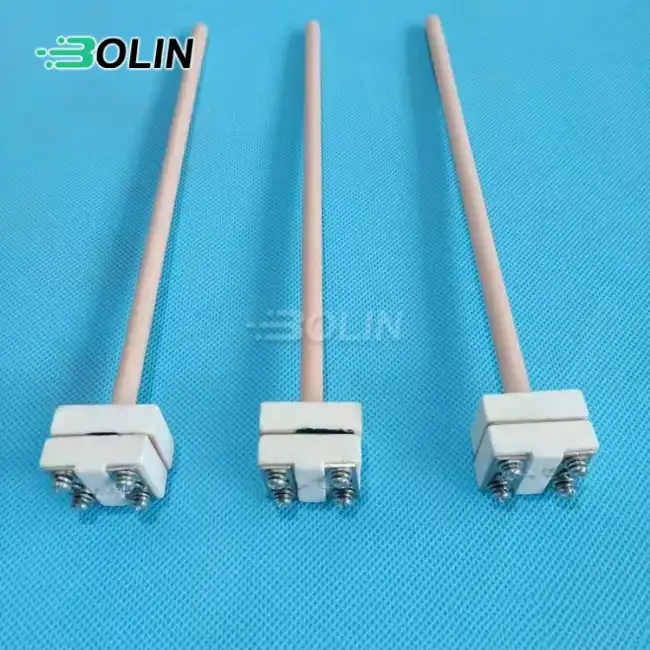
Understanding Custom Thermocouples and Their Functionality
The Basic Principle Behind Temperature Measurement
It measures temperature via the Seebeck effect. Two metal lines connect at the sensor tip. A tiny charge forms at this junction when heated. This power is temperature-dependent. Workplace issues cause problems. Standard sensors have standard sizes and cover materials. They fail when corrosive gases damage common metals, restricted space pushes probes at strange angles or lengths, rapid flows induce vibration and mechanical stress, or thermal shock from short heating and cooling cycles.
How Customization Addresses Your Process Challenges
Custom production plans for every issue. Sheath selection is crucial. Stainless steel 310 can withstand 1200°C acidity. Ceramic sheaths expand this range and defend against chemical assault in carburizing or nitriding ovens. Insulation choices matter too. Crushed magnesium oxide fills the thermocouple wire-cover gap. This material swiftly transfers heat to the sensory joint and blocks electricity at extreme temperatures. Your installation demands determine the terminal head form, protective tube arrangement, and connection type. Compression valves are good for maintenance. In controlled environment furnaces, flanged connections lock firmly to prevent leakage.
Common Thermocouple Types and Their Customization Potential
Numerous commercial applications still employ Type K Thermocouples, which are the most cost-effective and can function in numerous temperatures. They may not operate well in lowering atmospheric procedures. Type J Thermocouples function effectively at low pressures but have a limited temperature range. Type T Thermocouples are better at measuring very low temperatures, making them suitable for cold applications. Type S, R, and B Thermocouples can withstand temperatures beyond 1600°C and are commonly covered with molybdenum or tantalum for tough conditions. Each type's junction configurations may be adjusted to meet measurement objectives and electromagnetic interference issues. Junctions can be grounded, ungrounded, or uncovered.
Key Benefits of Custom Thermocouples in High-Temperature Applications
Superior Measurement Accuracy and Process Control
Accuracy makes heat treatment lucrative. Custom-engineered temperature monitors decrease measurement error by employing the correct sensor parts and testing processes. SLE Wire has half the tolerance of conventional wire because to its pure alloys. This reduces measuring errors and improves consistency. This precision is crucial for creating airplane parts or medical implants from metals that must fulfill tight criteria. Because data is more reliable, fewer parts are denied, and repair costs drop.
Extended Durability in Harsh Industrial Environments
The structure is strengthened using advanced sheath and insulation materials to withstand acidic, oxidizing, and abrasive conditions. Carbonitriding and carburizing require devices that can tolerate high carbon and rapid temperature fluctuations. Ceramic custom thermocouples can withstand chemicals and measure correctly during the soak and cool cycle. Upgraded materials prolong product life and reduce repair visits, lowering the total cost of ownership. Environment-specific custom thermocouples survive three to five times longer.
Flexible Integration Across Multiple Industries
Manufacturing requires temperature management for product quality, worker safety, and process speed. In cars, these sensors check engine part temperatures to ensure proper operation and minimum emissions. Aerospace applications require sensors to monitor turbine and engine temperatures in extreme conditions when safety is paramount. Custom temperature sensors provide safety and efficiency in fossil fuel, nuclear, and green power plants. Accurate temperature readings throughout manufacturing, processing, and storage help the food industry maintain safety and quality. Each business benefits from Customization that handles particular issues like strange forms or environmental protection.
These benefits reduce downtime, improve product consistency, and extend tool life, solving production issues. Matching temperature sensors to your demands provides operating stability that typical solutions can't match.
Comparison: Custom Thermocouples vs Standard Thermocouples for High-Temperature Use
Performance Differences Under Extreme Conditions
Ordinary thermocouples have standard specifications for most circumstances. They usually work at 1000°C with standard sheath materials. Custom versions have a larger working range and stabilize sensors better after prolonged heat exposure. Depending on calibration and cover material, customized sensors can function at 1700°C or more in vacuum or neutral atmospheres. Metalworking procedures that need high temperatures for welding, sintering, or crystal formation require this added functionality.
Total Cost of Ownership Analysis
Specialized temperature monitors cost extra, but their dependability and process outcomes make it worth it. Initially, 30–40% cheaper, standard sensors need to be replaced more regularly in severe environments. Custom solutions reduce unplanned repair shutdowns and eliminate detection drift or failure-related process modifications and expenses. Business case studies demonstrate that specialized sensors tuned for critical process controls reduce downtime, increase production, and reduce upkeep costs within 18 to 24 months.
Material and Construction Advantages
Better sheath metals and insulation distinguish custom-built sensors. Inconel sheaths rust and corrode better than stainless steel. Tantalum and molybdenum can withstand high heat and chemicals. In vacuum ovens and controlled environment systems, high-purity insulation prevents contamination. Custom wall thicknesses and high-pressure compression joints allow operating pressures beyond 10,000 PSI. These material selections affect sensor lifespan and measurement accuracy in ways that conventional solutions can't.
How to Select and Install the Right Custom Thermocouple for Your Application
Evaluating Your Process Requirements
Consider your application environment, temperature range, and size constraints when choosing custom thermocouples. Record your process's highest and lowest temperatures. Find any dangerous fumes, chemicals, or impurities in the furnace's air. Check sensor installation space and entrance obstacles. Consider if thermal cycling is part of your process and how rapidly temperatures vary. Knowing these criteria ensures that your sensor will perform dependably over time.
Matching Technical Specifications to Your Needs
The thermocouple type determines temperature range and accuracy. Type K can handle most daily duties at 1200°C. Type R or S is more accurate at 1000–1600°C. You can choose stainless steel 310 for oxidizing conditions, Inconel 600 for corrosion protection, or ceramic for difficult applications. Measure from where you want it to go to the sensor to get the proper length. Choose a link type depending on how well it works with your control system and how you maintain it.
Installation Best Practices and Maintenance Guidelines
Sensors must be properly fitted to be accurate and durable. Place the sensor tip where it matches the desired temperature. Avoid dead zones and extreme temperatures. Shaking can harm sensors, use thermal expansion-resistant mounting techniques. Avoid frequent blunders, including placing sensors near heat sources or on the job. Schedule regular testing. Sensors in hot or corroded regions should be examined annually for alloy depletion drift. Keep detailed records of testing findings to discover patterns that may indicate a need for replacement before it fails.
Procurement Insights: Ordering Custom Thermocouples for High-Temperature Applications
Understanding Lead Times and Ordering Quantities
You must understand manufacturer wait periods, minimum order quantities, and how Customization influences prices to execute successful procurement. Standard configurations may be shipped in days, while unique designs take four to six weeks to create, manufacture, and test. Ordering in bulk reduces unit costs by 15–25%, and manufacturers can optimize manufacturing runs to reduce shipment times. Consider these factors while arranging your purchasing timetable, especially for new furnace systems or major equipment.
Selecting a Qualified Manufacturer
You may trust a reputed manufacturer with the necessary certifications for quality, skilled advice, and industry standards. Find NIST-traceable testing suppliers. This allows several temperature tests over your desired range. Good manufacturers inspect internal joint welds and magnesium oxide insulation for holes with X-rays. Hermetic seals for vacuum or high-pressure locations are verified by helium leak testing. Electrical isolation between the element and the sheath is proven by insulation resistance testing. These quality control processes distinguish between acceptable and trusted suppliers.
Communicating Your Technical Requirements
Technical demands should be thoroughly understood at the quote request to increase order accuracy and save costly adjustments or delays. Provide data like temperature range, atmospheric composition, physical measures, mounting technique, and preferred connection type. Include installation form and room limits blueprints if possible. Include particular demands like unground joints to prevent electrical flow or error wire restrictions for accuracy. Ask vendors about their experience with similar apps and for examples from employees. This rigorous approach to procurement ensures that the sensors you obtain fit your business needs and timetables.
Conclusion
Custom thermocouples are a good investment for industrial producers that need to detect temperatures precisely in demanding heat treatment circumstances. Their specific design addresses your process's particular issues, such as corrosive conditions, limited space, huge temperature changes, and quick heat cycles. Better precision, longevity, and integration improve process control, product quality, and operational efficiency in measurable ways. In industries where precision directly affects earnings, choosing the proper temperature sensors and working with a respected maker gives you the measurement accuracy you need to stay ahead of the competition.
FAQ
Can custom thermocouples measure temperatures above 1600°C?
In vacuum or neutral atmospheres at 1700°C or higher, custom sensors with Type R, S, or B calibrations and molybdenum sheaths perform consistently. The highest limit depends on the sheath material and protective environment.
How often should I calibrate my temperature sensors?
The frequency of calibration depends on temperature and environment. Calibration is required annually for sensors below 1000°C in non-corroding settings. Temperatures exceeding 1200°C or acidic environments should be monitored every six months because metal loss and contamination accelerate measurement drift.
Are wireless temperature measurement solutions available?
Wireless Custom Thermocouple solutions are offered when standard wiring is not possible. Batteries power transmitters that send temperature data to central tracking systems. But they only operate well below 500°C since high temperatures limit battery life and make computer parts less trustworthy. For high-temperature usage, wired cables are still safer.
Partner with Bolin for Your Temperature Measurement Needs
Hebei Bolin Electric Furnace Manufacturing Co., Ltd. has extensive thermal engineering and heat treatment tool knowledge to assist with temperature measurement. Our engineering team designs Custom Thermocouple solutions for all of our furnace manufacturing lines, including roller hearth, mesh belt, vacuum, and brilliant annealing systems. We support our custom thermocouples for sale from design to installation and servicing as a quality and creative firm. Talk to our technical specialists at 15720259172@163.com about your particular application demands and obtain an estimate for sensors that fit your process.
References
1. McGee, Thomas D. "Principles and Methods of Temperature Measurement." John Wiley & Sons, 1988.
2. Kinzie, Paul A. "Thermocouple Temperature Measurement." John Wiley & Sons, 1973.
3. Nicholas, J.V. and White, D.R. "Traceable Temperatures: An Introduction to Temperature Measurement and Calibration." John Wiley & Sons, 2001.
4. Pollock, Daniel D. "Thermocouples: Theory and Properties." CRC Press, 1991.
5. Bentley, Robert E. "Handbook of Temperature Measurement Volume 3: The Theory and Practice of Thermoelectric Thermometry." Springer, 1998.
6. Burns, G.W. and Scroger, M.G. "Temperature-Electromotive Force Reference Functions and Tables for Letter-Designated Thermocouple Types." National Institute of Standards and Technology Monograph, 1993.
Learn about our latest products and discounts through SMS or email